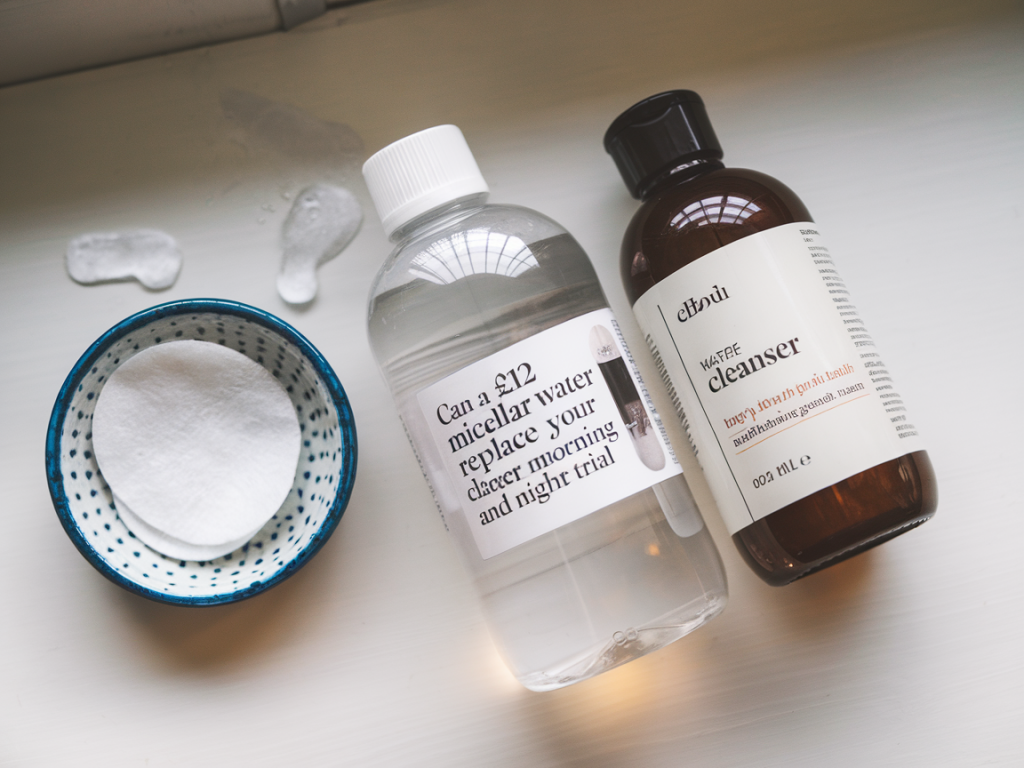
I decided to put a popular budget favourite to the test: a £12 micellar water as my sole cleanser for two weeks, morning and night. I’d seen it pop up in countless TikToks and Instagram reels — people saying micellar can replace your cleanser, simplify your routine, and still keep skin happy. As someone who loves an uncomplicated routine but also hates trading results for convenience, I wanted to know: is this a time-saver or a compromise?
Why I picked micellar water (and which one)
Micellar water has been marketed as a gentle, no-rinse cleanser that lifts dirt, oil and makeup with minimal fuss. It’s essentially water with tiny micelles — little oil molecules — suspended in it to attract grime. For the trial I chose a widely available, well-reviewed option that retails around £12 and is sold at major UK retailers (you’ve probably seen it on the shelves). I won’t name a specific retailer here, since formulations vary, but the version I used was fragrance-free, marketed as suitable for sensitive skin, and came in a 400ml bottle.
My skin baseline: combination, leaning oily in the T-zone, a few hormonal breakouts on occasion, and generally sensitive to heavy fragrances. In other words, a decent test subject for whether a simple micellar water can hold its own morning and night.
How I structured the two-week trial
I kept everything else in my routine constant so I could isolate the effects of swapping out a traditional cleanser. Here’s what I did each day:
- Morning: apply micellar water on a cotton pad, sweep across face and neck; if needed, a second pad to ensure no residue; pat dry; follow with serum and SPF.
- Night: remove makeup first if it was heavy (I used the same micellar water on a cotton pad for eye and face makeup), then use micellar water again across the skin; finish with my usual nighttime products (retinol/niacinamide depending on the night).
- No double-cleansing. No splash-with-water step. No additional clarifying masks during the two weeks.
Week 1 — what I noticed
First few days were promising. The micellar water felt lightweight and non-stripping. It removed my light morning creams and most daytime oils easily, and on evenings when I’d worn minimal makeup it took everything off with gentle swipes. I enjoyed the convenience — no need to stand at the sink, and no leftover tightness.
There were some caveats though:
- Makeup removal: It handled light foundation and tint surprisingly well, but on nights I wore long-wear mascara or a full-coverage foundation, I needed a few extra pads and some careful swiping around the eyes. It removed eye makeup, but not as efficiently as an oil cleanser or a dedicated eye makeup remover.
- Texture and residue: The skin felt soft — not squeaky clean — which I usually like. But I occasionally felt a faint film, especially midweek when I used a night cream. That feeling went away after the next step in my routine, but it made me wonder about how deep the micellar water was actually cleansing.
Week 2 — the deeper test
By the second week I was more confident with application technique: two passes, one for makeup removal and one for a deeper sweep. My skin looked stable; there was no flare-up of irritation and no dramatic improvement in texture either. A few interesting points emerged:
- Breakouts: I had a small hormonal spot appear mid-trial, but I don’t attribute that to the micellar water. It behaved like my usual blemishes — surfaced then calmed with targeted treatments.
- Pore experience: My T-zone still accumulated sebum by mid-afternoon, same as usual. I didn’t notice a reduction in breakout-prone areas, which makes sense since micellar water won’t exfoliate or deeply unclog pores the way a charcoal or clay-based cleanser can.
- Comfort: Overall comfort was the biggest plus. No dry patches, no tightness, and fewer steps in my routine felt really freeing on rushed mornings.
Quick comparison table: micellar water vs. traditional cleanser
| Criteria | Micellar water (£12 test) | Traditional cleanser (foam/gel/cream) |
| Makeup removal | Decent for light makeup; needs extra effort for waterproof/long-wear | Generally more effective, especially oil-based or balm cleansers |
| Gentleness | Very gentle; few signs of irritation | Varies by formulation; can be stripping or hydrating |
| Pore-cleansing/exfoliation | Limited | Can be targeted (with AHAs/BHAs or specific actives) |
| Convenience | High — no water needed | Lower — rinse required |
Who will love this approach
If your mornings are rushed, you rarely wear heavy makeup, and you prioritise a gentle, minimal routine, a good micellar water can be a real game-changer. It’s also great for travel, camping, or situations where access to water is limited. For people with very sensitive skin who react to surfactants in cleansers, micellar water can be a kinder alternative.
When I wouldn’t recommend replacing my cleanser
There are definitely situations where I wouldn’t advise ditching a traditional cleanser:
- If you wear heavy or waterproof makeup regularly — you’ll likely need an oil-based cleanser or a proper makeup remover first.
- If you use actives like retinoids, AHAs/BHAs, or need a deeper pore cleanse — micellar water doesn’t substitute for chemical or physical exfoliation.
- If you have very oily, congested skin that benefits from a clarifying foam or clay-based product.
Practical tips if you want to try it
- Use separate pads for eyes and face to avoid transferring eye-residue across the skin.
- Try a double-swipe method: one pass to remove makeup, one to cleanse — especially at night.
- Follow with your usual serums and SPF in the morning — micellar water shouldn’t replace sunscreen or treatment products.
- Introduce it gradually if you’re swapping from an active-heavy routine so you can monitor changes in breakouts or texture.
Final thoughts from two weeks
After fourteen days, I wouldn’t replace my regular cleanser completely with a £12 micellar water — but I’d happily keep one in my bathroom cabinet. It’s an excellent tool for simplifying mornings, removing light makeup, and caring for sensitive skin without fuss. For me, the best approach is hybrid: micellar for mornings, travel and lazy nights; a proper cleanser (or double-cleansing when I’ve worn heavier makeup) when I need a deeper clean.
If you’re curious, give a two-week trial a go with your own baseline in mind. Track how your skin feels (tightness, oiliness, breakouts) and the makeup removal effectiveness, and then decide whether it’s a replacement or a welcome addition to your routine.