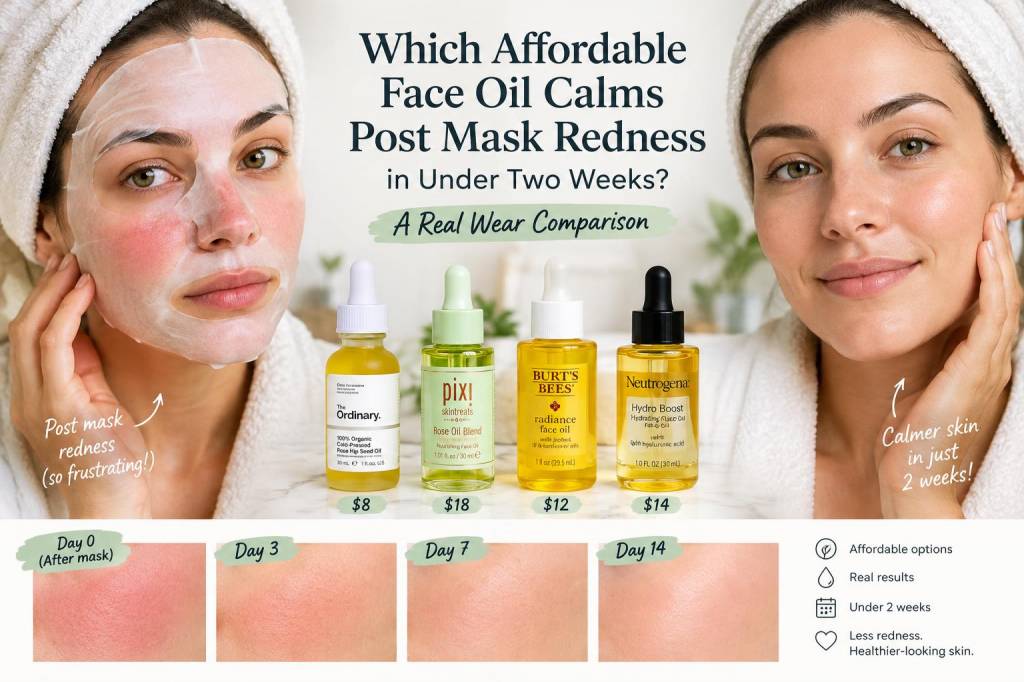
Wearing a mask for long hours brought with it an unexpected side effect: my skin started to flare with redness along the nose, cheeks and chin — the classic "maskne" redness that no amount of concealer seemed to hide. I wanted something simple, soothing and affordable that would calm the inflammation fast. Over two weeks I tested five budget-friendly face oils in real life (morning and evening, paired with my usual moisturizer) to see which one actually reduced post-mask redness and irritation in under 14 days. Here’s what I tried, how I tested them, and the results.
Why a face oil?
People often assume oils make skin greasier or worse for breakouts, but for redness and compromised barrier function an oil can be protective and anti-inflammatory. Oils rich in linoleic acid (like rosehip or grapeseed), antioxidants (like vitamin E and rosehip), or anti-inflammatory components (like squalane and jojoba) can help restore the skin barrier, lock in moisture and reduce visible redness. I wanted oils that were non-comedogenic, lightweight, and available at drugstore prices.
The oils I tested
I chose five accessible, affordable oils that I could buy online or at a pharmacy in the UK. I used each oil for a minimum of three consecutive days before switching to the next — overall two weeks of continuous wear — and I kept the rest of my skincare routine stable (gentle cleanser, hydrating serum, light moisturizer, SPF during the day).
| Product | Main actives | Price (approx.) | Texture |
|---|---|---|---|
| The Ordinary 100% Plant-Derived Squalane | Squalane | £6–£10 (30 ml) | Very light, non-greasy |
| Trilogy Rosehip Oil | Rosehip oil (retinoic acids precursor, antioxidants) | £8–£15 (small bottles vary) | Light but slightly more viscous |
| Rose & Co. Sweet Almond Oil | Sweet almond oil (oleic acid) | £4–£8 | Richer, slightly heavier |
| Garnier Pure Active Soothing Oil (Grapeseed blend) | Grapeseed oil, vitamin E | £5–£9 | Light-medium |
| La Roche-Posay Lipikar Huile AP+ (body & face usage) | Niacinamide + shea, oils | £8–£12 (small travel) | Light milky oil |
How I tested them (the real-wear method)
My goal was to replicate everyday life, so I applied 2–3 drops after my serum and before my moisturizer, morning and night, for each oil. On days I worked outside the home I kept wearing my mask for several hours. I tracked skin redness on a scale of 0–5 (0 = no redness, 5 = very inflamed) and took photos in natural light at the same spot each morning. I also noted any new breakouts, texture changes, or reactions.
What I was looking for
The results — what calmed redness fastest
Here’s how each oil performed in my two-week, real-wear trial.
The Ordinary 100% Plant-Derived Squalane
This was my surprise winner. Squalane felt weightless, absorbed quickly and didn’t ball up under my sunscreen or makeup. I noticed a visible reduction in diffuse redness by day 5 and a consistent improvement by day 10 — my redness score dropped from a 3 to a 1. Squalane’s barrier-repairing, non-comedogenic profile seems ideal for irritated, mask-prone skin.
Trilogy Rosehip Oil
Rosehip took a close second. Because it contains pro-retinoic acids and antioxidants, it worked well to calm inflamed areas and promote skin repair. I saw meaningful reduction in redness around day 7, and over 14 days my skin tone looked more even. It was slightly more noticeable under makeup (a gentle patting technique helped), but I appreciated the long-term repair benefits.
Garnier Grapeseed blend
This felt lightweight and soothing thanks to grapeseed and vitamin E. I noticed mild improvement by day 6–7, but it wasn’t as dramatic as squalane or rosehip. It’s a great budget pick for someone who wants antioxidant protection and a light feel.
La Roche-Posay Lipikar Huile AP+
While marketed more for body use, this milky oil performed well on irritated skin because of its combination of oils and niacinamide. It calmed redness moderately quickly (about day 7), and I loved how soft my skin felt. It’s slightly less pocket-friendly but excellent for sensitive, dry skin that needs a kinder touch.
Sweet Almond Oil
Sweet almond oil hydrates beautifully but felt a touch heavy in mask-wear. In my testing it reduced tightness but did not reduce redness as quickly; improvements were more about comfort than visible color correction. For acne-prone skin I’d be cautious — it felt a bit comedogenic on my chin after extended mask use.
Which one would I reach for and for whom?
If your main ask is: Which affordable face oil calms post-mask redness in under two weeks? — I’d reach for The Ordinary squalane first. It’s light, inexpensive, and gave fast, visible relief without making my mask slip or causing breakouts. It’s excellent for combination, normal and slightly sensitive skin.
If you want added regenerative benefits (and can handle a slightly more noticeable oil under makeup), Trilogy Rosehip is my pick for evening repair and long-term tone improvement. For very dry, irritated skin that needs barrier support with niacinamide, consider La Roche-Posay Lipikar Huile. For antioxidant support at a low price, the grapeseed blend from Garnier is a solid middle-ground.
How to use an oil under a mask without problems
Final practical tips from my two-week wear test
Mask-wear didn’t have to mean resigned redness. For me, an affordable, lightweight oil was the fastest, simplest way to calm inflammation without overcomplicating my routine — and that’s exactly the kind of beauty fix I love to share: practical, effective, and usable in real life.