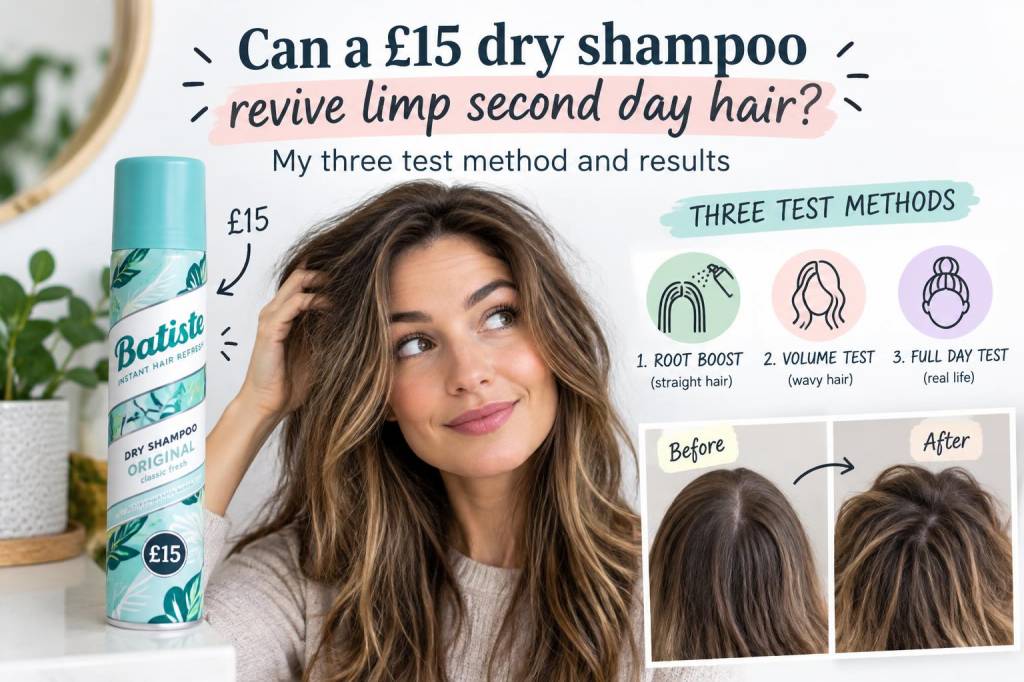
Second-day hair: the moment when your reflection suddenly feels a little flat, a bit greasy at the roots, and you find yourself reaching for anything that promises volume and life. I wanted to know whether a mid-priced dry shampoo — one that costs around £15 — could genuinely revive limp hair without leaving that telltale white cast, crunchy residue, or weird scent. So I ran a small, practical experiment: three tests across different hair types and styling scenarios to see what this dry shampoo could actually do in real life.
Why this test and what I hoped to learn
I’ve used plenty of dry shampoos over the years, from budget supermarket brands to salon-priced powders. Some work well enough if your goal is masking oil; others promise volume and deliver nothing but grit. My questions were simple and specific:
To keep things relevant, I tested the product on hair that's fairly common: medium-fine density, natural-to-limp waves, and a mix of colour-treated and natural roots. I also included two variations — using the dry shampoo alone, using it before heat-styling, and using it at the roots plus a light refresh of the lengths — to mimic how most of us actually use these products.
What I used
The product I tested was a £15 aerosol dry shampoo from a well-known drugstore brand (I’m keeping the brand unnamed here to focus on practical results, but I’ll note specifics in the product notes below if you want them). Key claims on the can were: oil absorption, instant volume, and no visible residue. Ingredients included common starches and alcohols typical of dry shampoos, plus a light fragrance.
For context, here’s the hair I tested on:
My three-test method
I designed three realistic scenarios that mirror how people actually reach for dry shampoo:
I repeated each test three times over different days to avoid one-off flukes and to check consistency. Between tests I washed my hair normally to reset product buildup.
How I applied it (step-by-step)
Results — the numbers and the feel
Below is a simple table summarising my observations across the three tests. I judged each on four criteria: oil absorption, visible residue, volume boost, and scent/feel. Scores are subjective on a 1–5 scale (5 being excellent).
| Test | Oil absorption | Visible residue | Volume boost | Scent/feel |
|---|---|---|---|---|
| Quick Fix | 4 | 3 | 3 | 4 |
| Pre-Style Booster | 3 | 2 | 4 | 4 |
| Root Refresh + Length Mist | 4 | 2 | 3 | 4 |
Here’s what those numbers felt like in practice:
What I liked
What annoyed me
Practical tips from my tests
Product notes and considerations
The formulation contains starch-based absorbers mixed with alcohol for quick evaporation. That combination does a good job at absorbing oil but can be drying if used excessively on the lengths. If your hair is already dry or brittle, limit application to the roots and follow with a small amount of hair oil on the ends when you wash.
Also worth noting: a £15 price point sits in a sweet spot where you get a more refined fragrance and a slightly better spray mechanism than bargain brands, but you’re not paying for salon-grade niceties. It’s practical and reliable rather than transformative.
If you want my quick recommendation for using a product like this: keep expectations realistic. It’s great for postponing a wash, adding texture, and helping styles hold, but it won’t replace a thorough wash or fix underlying scalp issues. For everyday second-day hair revival, used correctly, it’s a useful tool in my routine.